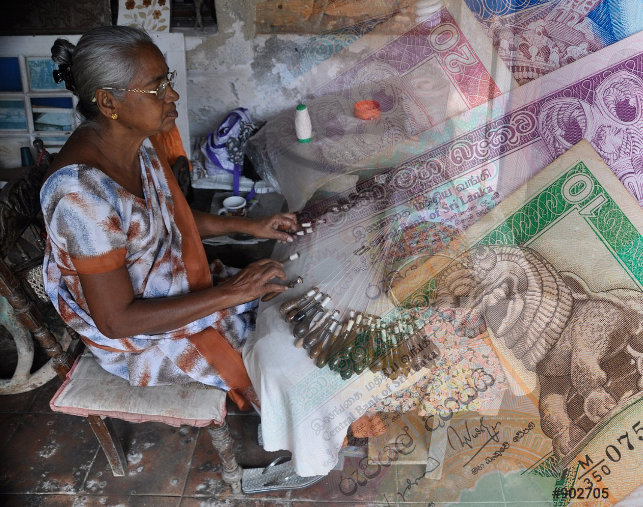
Like most currency in the world, the SLR is a “fiat” currency. This mean the SLR has no real value and its value is base only upon the faith in which, the central bank and government, make us believe it has. Doing so, the government makes us believe that we can exchanged SLR for goods and services. The SLR banknotes are printed at the discretion of the central bank and government, to pay for the goods and services they acquire. The more banknotes (money) they print, the less we have faith in the value of the SLR, hence why it is loosing its value and why we constantly need more and more SLR to buy the same goods and services, that never increased value...
A "commodity" currency is a currency backed by tangible goods (gold, land, gem stones, physical resources, etc.). A "commodity" currency banknote is an official receipt that can be exchanged at any time for a tangible good kept in the public treasury. A "commodity" currency has therefore real tangible value. As opposed to a "Fiat" currency, the central bank or government cannot print a "commodity" currency without first securing a "commodity" in the public treasury, to backup the new emitted "commodity" currency value. As goods retain a constant value over time, so does a "commodity" currency!
A “digital” currency is a currency that can be exchanged through digital communication devices (computers, smartphone...) without the need of carrying around physical banknotes. A “crypto” currency, is a “digital” currency that is exchanged and controlled by a Public Ledger. This mean all the transactions are encrypted then posted, anonymously, on a Blockchain so they can’t be tampered with by anyone without raising the public attention. Bitcoin is an example of a “Fiat - crypto” currency that has no intrinsic value. Sri Lanka’s financial solution first begin by the creation and establishment a new “Crypto- Commodity” currency: The “eRs” (electronic Rupees)!
Crypto-Commodity Currency “eRs”
Once we create a new 100% digital crypto-commodity currency "eRs", there will be no need for physical banknotes. No more printing, counting, transporting, withdrawing or depositing banknotes! This would save time and energy as all money will be transferred electronically. The money will be loaded on a smartphone via the internet or on a personal smart debit card (QR code Id and NFC for contactless payment), which can be reloaded everywhere (ATM, merchants, etc.).
As the currency will be 100% supported by commodities, it would be easy to permanently fix inflation at 0%. This means that the price of goods and services will never increase in the future...
It will therefore be useless, for greedy importers and manufacturers of goods, to hold the goods in a warehouse, creating an artificial scarcity, hoping to then resell the goods at a higher price. There will never be a higher resale market value... On the contrary, the sale price of goods will gradually decrease over time due to factory automation!
The banking interest rate creates inflation, therefore the banking system will be restructured with a strict 0% interest rate policy (for loans and deposits). When granting a loan, the bank will have to share the risk with the client and not only benefit from him. For example: if a farmer needs a loan to buy fertilizer, the bank could ask for 5% of the next harvest as compensation. If the farmer has a good harvest, the bank will have a good profit. If the farmer has no harvest, both the farmer and the bank will lose. This would create closer cooperation and better motivation towards the bank to help and support the client in his project.
Administrative simplification
Running the economy on a multitude of blockchains will greatly simplify the administrative system. This will provide 100% transparency on all public funds managed, preventing misappropriation of the public treasury. It will automatically collect taxes on sales, duties and wages: no more tax evasion! ...and it will provide, in real time, the complete state of Sri Lankan finance and economy.
No need for anyone to file a tax return! Permits will be reassessed, produced and paid for automatically. An election, vote or referendum could be produced almost at no cost and within a day if necessary. The "food and goods" national inventory and forecasts will be known in real time, for better planning and distribution... For any import and export, taxes and customs will already be paid and cleared before the goods arrive or leave Sri Lanka... These are just a few examples of what could be done. All this will require 80% fewer state employees and buildings, which will be reallocated to other functions, mainly as for nationalized companies.
Automatic reimbursement of the national debt
Sri Lanka is a wealthy country that has been blindly robbed by greedy investors, corporations, banks and politicians.
The country has abundant high quality natural resources that could create a paradise for all its citizens! Governments must stop acting like beggars and take the economic issue into their own hands! Public credit or deficit must be prohibited and the government must always plan a balanced budget with a minimum surplus of 10%.
Sri Lanka's national debt is denominated in the foreign "Fiat"currency. With a "Crypto- Commodity" currency at 0% inflation, all foreign currencies will devalue sharply year after year against the "eRs". This means that the debt will also be automatically devalued. For example, if you owe $1 USD, you now owe 380 eRs/-. If next year the USD devalues, it could become $1 USD = 304 eRs/-. It's the equivalent of repaying 20% of the debt without having to pay anything! A crypto-commodity currency with 0% inflation is a key element against corruption and debt burden.
Central Bank & Blockchain
The central bank function will be decentralized. Blockchains will drive the economy and the central bank will receive 0.5% of all transactions in payment (note: VISA, MasterCard, Amex and most bank cards charge 1.5% to 4%). All citizens running public blockchain algorithms on their smartphones and computers, to support the financial system, will receive financial incentives from the central bank. These incentives will be some tax credits applicable on daily transactions in Sri Lanka. Offering tax credits will prevent foreign countries, nationals or corporations, from taking control of Sri Lankan blockchains as the tax credits will be of no value to non-Sri Lankan citizens...The value produced in Sri Lanka will therefore remain in Sri Lanka!